Pure Consciousness • Based on Bhagavad Gita 2.11 - 2.30
1. Introduction: Who Are You?
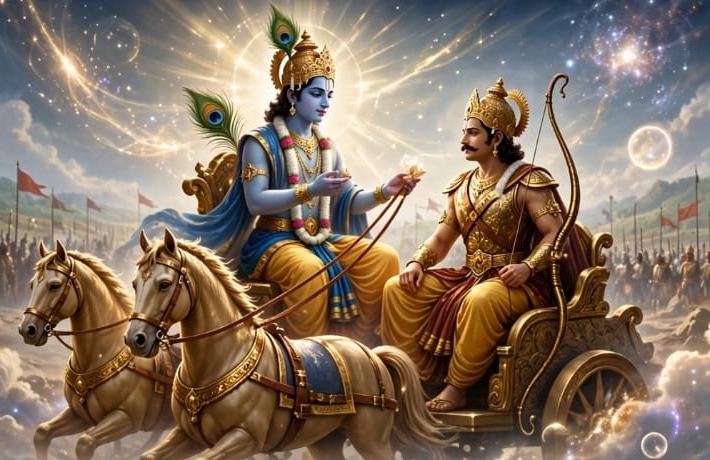
In the Bhagavad Gita, on the battlefield of Kurukshetra, Arjuna is broken by grief. He does not want to fight because he thinks he will kill his own teachers, elders and relatives.
Sri Krishna does not start by teaching him war strategy. He starts by teaching him Self-Knowledge - Atma Jnanam.
His first teaching is simple and revolutionary:
You are not the body. You are the Atman - the eternal Self living inside the body.
The body is born and dies. The Atman never is born, never dies. To understand life, death, duty and liberation, we must first understand this difference.
This is the foundation of the entire Gita.
2. The Atman - The Eternal Self
The Atman is described in the Gita as:
- Indestructible - Cannot be destroyed
- Unborn - Never created
- Immutable - Never changes
It is not a thing, not a thought, not an emotion. It is Pure Consciousness - the light by which we know everything else. The body changes, the mind changes, thoughts come and go, but the witness who sees all these changes remains the same. That witness is the Atman.
3. Key Verses From Bhagavad Gita
Verse 2.20 - The Atman Is Never Born, Never Dies
na jayate mriyate va kadacin
nayam bhutva bhavita va na bhuyah
ajo nityah sasvato'yam purano
na hanyate hanyamane sarire
Meaning: The Atman is never born nor does it ever die. Having come into being, it never ceases to be. It is unborn, eternal, everlasting and ancient. It is not killed when the body is killed.
This verse destroys the fear of death. What dies is only the outer covering. The Self inside remains.
Verse 2.22 - The Example of Clothes
vasamsi jirnani yatha vihaya
navani grhnati naro'parani
tatha sarirani vihaya jirnany
anyani samyati navani dehi
Meaning: Just as a person discards worn-out clothes and puts on new ones, the embodied Self discards old, worn-out bodies and enters new ones.
Death is not an end. It is only a change of dress. Birth is not a beginning. It is only wearing a new dress. This is the law of rebirth.
Verses 2.23 - 2.24 - Beyond The Five Elements
nainam chindanti sastrani
nainam dahati pavakah
na cainam kledayantyapo
na sosayati marutah
Meaning: Weapons do not cut it, fire does not burn it, water does not moisten it, air does not dry it.
Everything in this material world can be cut, burnt, wet or dried. But the Atman is beyond all the elements. No weapon, no fire, no disaster, no disease can touch it.
4. Atman vs Deha - The Chariot Analogy
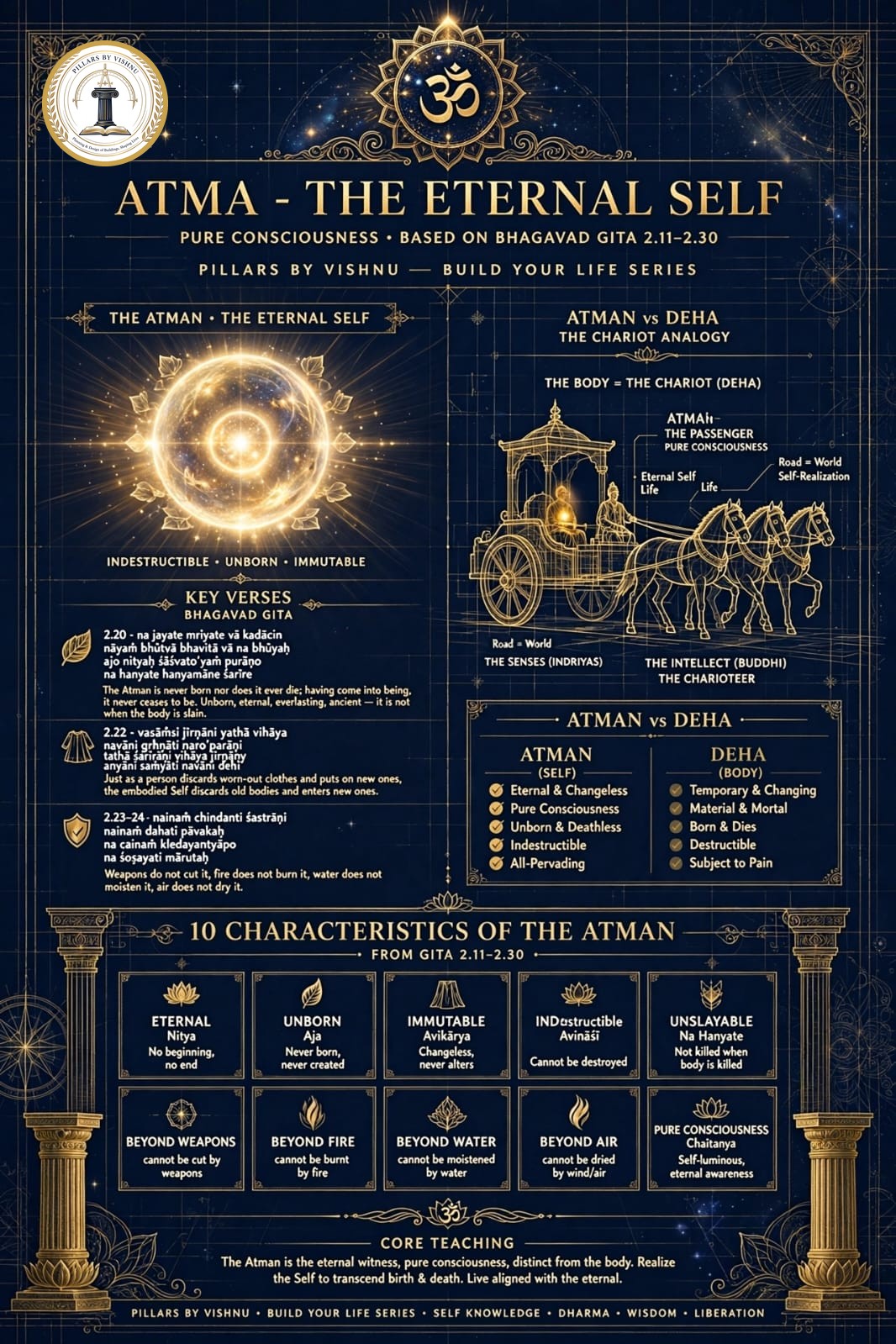
To explain the relationship between body and Self, our scriptures give the beautiful Chariot Analogy from the Katha Upanishad, which Krishna also implies in the Gita.
The Chariot = The Body - Deha
The Passenger = The Atman - Pure Consciousness, Eternal Self
The Charioteer = The Intellect - Buddhi
The Reins = The Mind - Manas
The Horses = The Senses - Indriyas
The Road = The World - The journey of Life
The Destination = Self-Realization
If the horses - the senses - are uncontrolled, the chariot goes anywhere and crashes. If the charioteer - the intellect - is wise and holds the reins - the mind - firmly, the passenger - the Atman - reaches its destination safely.
Most people think they are the chariot. The Gita says: You are the passenger.
5. Atman vs Deha - The Clear Difference
ATMAN (Self) vs DEHA (Body)
Eternal & Changeless vs Temporary & Changing
Pure Consciousness vs Material & Mortal
Unborn & Deathless vs Born & Dies
Indestructible vs Destructible
All-Pervading vs Limited to one place
Subject to no pain vs Subject to Pain, Disease, Ageing
The body is like a house. You live in it, but you are not the house. When the house falls down, you move out. The Atman is the resident, the body is only the residence.
6. The 10 Characteristics of The Atman (Gita 2.11 - 2.30)
1. Eternal - Nitya: No beginning, no end. It always was, always is, always will be.
2. Unborn - Aja: Never born, never created. It is self-existent.
3. Immutable - Avikarya: Changeless, never alters. Childhood, youth, old age affect the body, not the Self.
4. Indestructible - Avinashi: Cannot be destroyed by anyone or anything.
5. Unslayable - Na Hanyate: Not killed when the body is killed.
6. Beyond Weapons: Cannot be cut by weapons.
7. Beyond Fire: Cannot be burnt by fire.
8. Beyond Water: Cannot be moistened by water.
9. Beyond Air: Cannot be dried by wind / air.
10. Pure Consciousness - Chaitanya: Self-luminous, eternal awareness. It is the light that makes all knowing possible.
7. Core Teaching
The Atman is the eternal witness, pure consciousness, distinct from the body. Realize the Self to transcend birth & death. Live aligned with the eternal.
This is the core of Krishna's message to Arjuna:
1. Do not grieve for the body, because the body was always meant to change.
2. Do not fear death, because you, the Atman, cannot die.
3. Do your Dharma without attachment, because you are the eternal witness, not the doer who is bound by results.
4. Live aligned with the eternal, not with temporary pleasures and fears.
When a person realizes "I am Atman," he becomes fearless. Loss does not break him. Success does not bind him. He lives in the world, but is not of the world.
8. Conclusion: Build Your Life on The Eternal
Everything we build in life - house, wealth, name, relationships - is built on the body, which is temporary.
The Gita invites us to build our life on something deeper - on the Pillar of Atman.
When we know we are eternal, we stop living in fear and start living in Dharma, Wisdom and Liberation.
PILLARS BY VISHNU - Build Your Life Series
Self Knowledge • Dharma • Wisdom • Liberation